
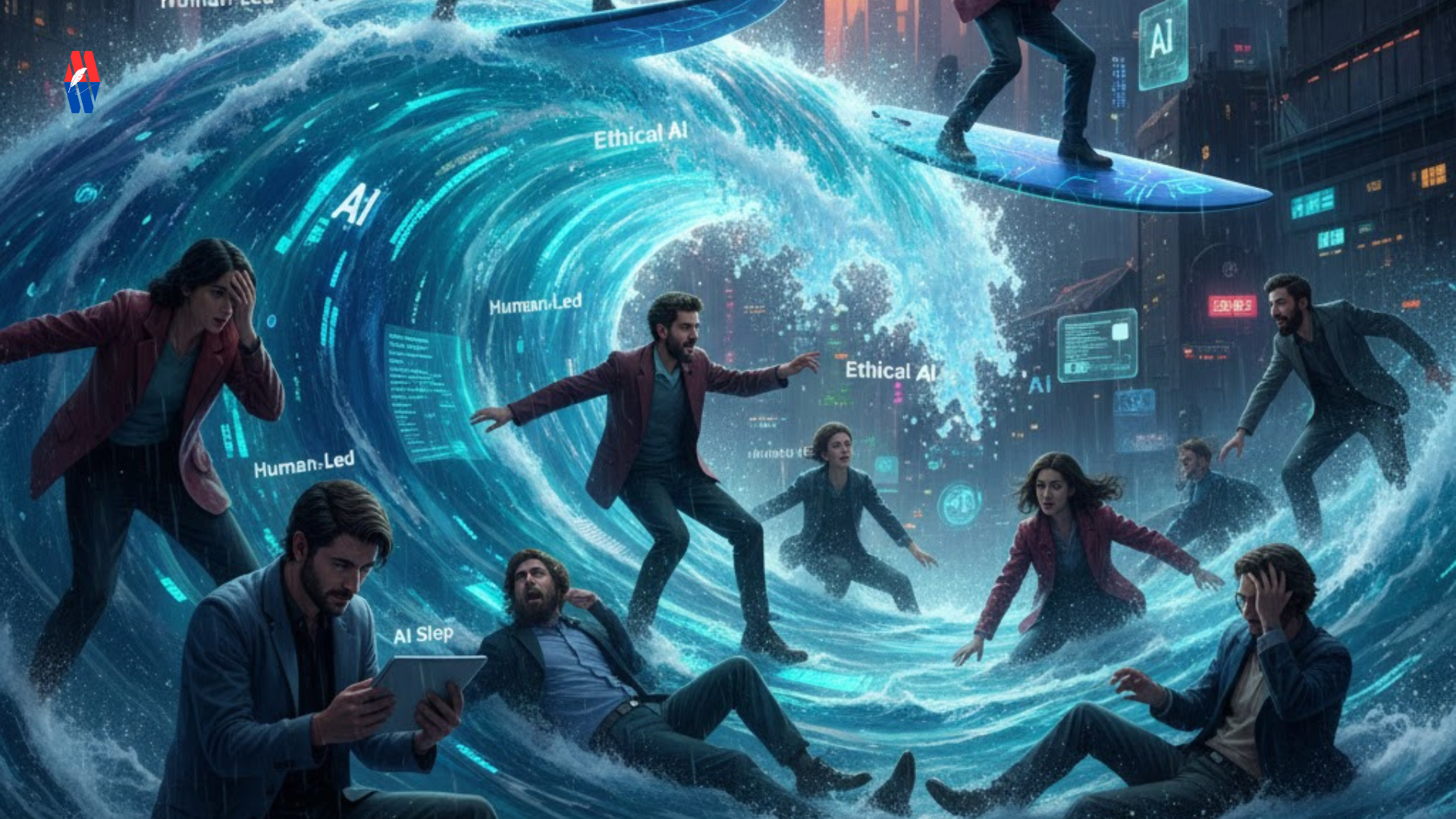
Remember when AI felt like a distant sci-fi movie? Something for Silicon Valley billionaires and robot dogs? Well, wake up and smell the algorithms, friends. It’s 2026, and the AI tsunami isn’t just on the horizon; it’s crashing over us, changing everything from how we work to how we argue on the internet.
It’s tempting to panic, or to preach doom and gloom. But the truth is, this isn’t a simple good-vs-evil story. We’re simultaneously drowning in the overwhelm and learning to surf the most powerful technological wave humanity has ever seen.
The Great AI Invasion: It’s Already in Your Pocket (and Your Fridge)
Think about your day.
- Your “smart” coffee maker probably uses AI to learn your morning routine.
- That annoying customer service chatbot that still can’t understand basic human emotion? AI.
- The incredibly accurate (and sometimes creepy) recommendations on Netflix, Spotify, and Amazon? All AI.
- Even your car’s anti-lock brakes are a rudimentary form of AI, making lightning-fast decisions you can’t.
We’ve moved beyond “AI is coming” to “AI is here, and it’s paying my bills (or trying to take my job).” It’s embedded, invisible, and frankly, a bit unsettling in its ubiquity.
The Upside: Why We’re All Secretly Loving It (Sometimes)
Let’s be real. There are some genuinely incredible benefits to this widespread adoption:
- Productivity on Steroids: Need to draft an email, summarize a monstrous report, or generate five ideas for your kid’s birthday party? AI can do it in seconds. This isn’t just about speed; it’s about freeing up mental bandwidth for the stuff that actually requires you.
- Democratization of Power: Suddenly, small businesses can access tools once reserved for corporate giants. A solo entrepreneur can have a sophisticated marketing strategy, customer service, and data analysis at their fingertips.
- Leaps in Science & Medicine: AI is accelerating drug discovery, identifying disease patterns, and even designing new materials. This is where the real, life-saving magic happens.
- Personalized Everything: From education tailored to a student’s learning style to hyper-specific fitness plans, AI promises a world where experiences are designed just for you.
It’s easy to get caught up in the shiny, efficient promise of it all. We are building a world that’s faster, smarter, and potentially more equitable in many ways.
The Downside: The Undercurrents of Concern
But beneath the surface, there are legitimate anxieties and very real disadvantages emerging:
- The “AI Slop” & Devaluation of Human Work: As I ranted about last week, the internet is becoming a landfill of algorithmically generated, perfectly bland content. This isn’t just annoying; it devalues the unique insights, creativity, and perspective of human creators. Why pay a writer when a bot does it for free? This is a serious threat to entire industries.
- Job Displacement (The Elephant in the Server Room): Let’s not mince words. AI is replacing jobs. Data entry, basic customer service, routine coding, graphic design, content generation—these are all ripe for automation. While new jobs will emerge, the transition will be painful and uneven, leaving many behind.
- Ethical Quandaries & Bias Amplification: AI learns from data. If that data contains historical biases (and it almost always does), the AI will perpetuate and even amplify them. We’re talking about biased hiring algorithms, discriminatory loan approvals, and even flawed justice systems.
- Security Nightmares & Deepfakes: The same tech that can create stunning art can also generate hyper-realistic fake videos, audio, and images—deepfakes—that can manipulate elections, spread misinformation, and destroy reputations. The truth itself is becoming harder to discern.
- The “Black Box” Problem: Many advanced AI systems are so complex that even their creators don’t fully understand how they arrive at their decisions. This “black box” nature makes accountability, auditing, and error correction incredibly difficult.
So, What Now? Drowning or Surfing?
We can’t put the AI genie back in the bottle. It’s out, it’s multiplying, and it’s changing our world at warp speed.
The challenge for us, as humans in 2026, isn’t to stop it. It’s to figure out how to leverage its power while safeguarding our humanity.
This means:
- Emphasizing uniquely human skills: Creativity, critical thinking, empathy, emotional intelligence—the things AI can’t fake (yet).
- Demanding ethical AI development: Pushing for transparency, accountability, and guardrails from developers and governments.
- Lifelong learning: The skills you have today might be obsolete tomorrow. Adaptability is no longer a buzzword; it’s a survival mechanism.
- Celebrating the “human touch”: Prioritizing real connections, authentic voices, and genuine experiences in a world awash with the artificial.
The AI tsunami is here. We’re all in the water. Some days we’ll feel like we’re drowning, overwhelmed by the sheer force of it. Other days, if we learn to position ourselves, we might just catch a magnificent wave.
What’s your take? Are you more excited or terrified by the pace of AI adoption? Share your thoughts below – no bots allowed in the comments section